
Oil and gas (O&G) companies operating across the UK continental shelf (UKCS) will have to adhere to a new range of net-zero-aligned obligations set out in a revised strategy recently announced by the UK Oil and Gas Authority (OGA).
The revised OGA Strategy supersedes the OGA’s original Maximising Economic Recovery (MER) Strategy, published in 2016, and includes the first legal obligation for the UK O&G industry to support the UK’s 2050 net zero target.
Specifically, the revised Strategy introduces two new high-level principles. These new principles commit the UK O&G industry to supporting and contributing to the UK’s net zero target, whilst also supporting investment in net-zero-aligned activities, e.g. carbon capture and storage (CCS), and hydrogen production.
The Maximising Economic Recovery (MER) Stragegy
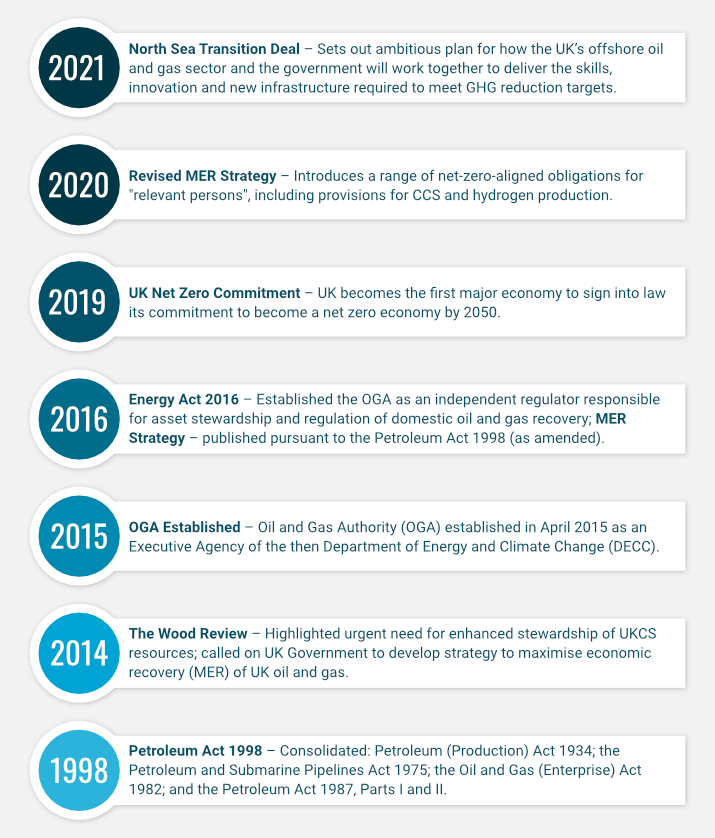
The MER Strategy is a legally binding document. It was developed following recommendations by The Wood Review, published in 2014. The Wood Review was commissioned by the UK Government to advise on how best to maximise economic recovery of oil and gas from the UKCS.
Recommendations from The Wood Review informed the UK Government of the urgent need for “enhanced stewardship of UKCS resources”, and for the establishment of an oil and gas regulatory body. In response, the UK Government established the Oil and Gas Authority (OGA) in April 2015, initially as an Executive Agency of the then Department of Energy and Climate Change (DECC).
The following year, the Energy Act 2016 established the OGA as an independent regulatory body charged with assest stewardship and regulation of UK domestic oil and gas recovery. In March of the same year, and pursuant to the Petroleum Act 1998 (as amended), the OGA published the first MER Strategy.
The 2016 MER Strategy focuses on net value creation for the whole of the UK through enhanced economic recovery of domestic oil and gas. The Central Obligation of the Strategy obliges “relevant persons” to take the “necessary steps” to secure “maximum value of economically recovered petroleum”.
Pursuant to the section 9F(3) of the Petroleum Act 1998, the OGA is obliged to review and, if necessary, revise the Strategy every four years — 2020 saw the first revision of the MER Strategy.
Timeline for relvant UK oil and gas policies
MER Strategy 2020 revisions
In 2019, the UK Government became the first major economy to legal commit to becoming a net zero economy by 2050. To achieve this an unprecedented commitment to reducing net GHG emissions is required from the whole UK economy, in particular from carbon-intensive industries such as O&G, cement and steel manufacturing.
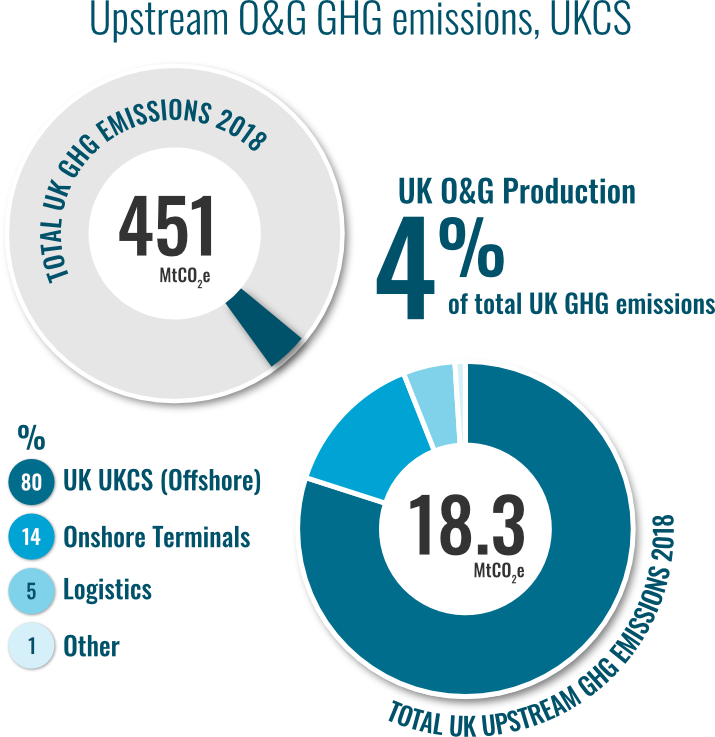
O&G production from the UKCS currently accounts for ~4% of the UK’s total GHG emissions, emitting ~18.3 million tonnes of carbon dioxide equivalent (MtCO2e) in 2018. Reducing and ultimately eliminating zet GHG emissions from UK oil and gas operations is, therefore, essential to the UK’s broader GHG emission targets.
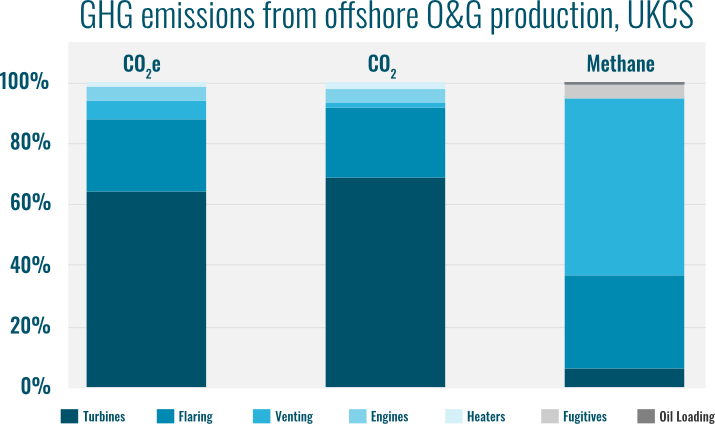
Across the UKCS, the majority of offshore GHG emissions represent carbon dioxide (CO2) and methane (CH4), which account for 89% (13 Mt) and 8% (44 kt) of emisions, respectively. Other GHGs, including nitrous oxide (N2O), account for the rest. Of these emissions, the primary sources of CO2 are gas-powered turbines (64%) and the flaring of combusted natural gas [methane] (24%). The majority of CH4 is derived from venting of non-combusted natural gas (57%) .
With growing pressure from industry stakeholders, in particular company shareholders, the revised OGA Strategy introduces two new high-level principles.
The first new principle makes provisions for the UK O&G industry to “assist the Secretary of State with meeting net zero,” and encourages industry to be “proactive in identifying and taking the steps necessary to reduce their greenhouse gas emissions as far as reasonable in the circumstances.”
The second new principle states that “relevant persons should consider their social licence to operate, and develop and maintain good environmental, social and governance practices in their plans and daily operations.”
The Central Obligation of the Strategy has also been amended and now includes a statement outlining the UK O&G industry’s responsibility to not only reduce sources of GHG emissions, but to also support carbon capture and storage (CCS) and hydrogen projects.
Implementing the revised MER Strategy
Whilst the OGA Strategy provides the regulatory foundation for the alignment of UK O&G production with national net zero commitments, it is Oil & Gas UK (OGUK) — the UK’s leading representative body for the UK offshore oil and gas industry — which has assumed the leading role in ensuring the Strategy is implemented.
In their recent publication, ‘Pathway to a Net-Zero Basin: Production Emissions Targets’, OGUK outlines a framework for making the UKCS a net zero basin (petroleum province) by 2050. This report forms part of OGUK’s initiative: Roadmap 2035: A Blueprint for Net Zero.
This framework presents an ambitious set of exploration and production emission targets set against a 2018 benchmark: 50% reduction in GHG emissions by 2030; 90% reduction by 2040; and 100% reduction by 2050.

OGUK emphasise the need for a combined approach to GHG reductions and have identified three primary means of reducing upstream emissions: (i) changes to operations, (ii) progressive reductions in flaring and venting and (iii) major capital investment programmes to decarbonise production operations.
To achieve reductions, OGUK has announced five specific primary work streams:
- Daily operational improvements.
- Reductions in flaring, venting and fugitives.
- Reducing emissions from power generation.
- Platform electrification and interconnectivity.
- Net zero projects: CCUS, blue and green hydrogen, decarbonisation hubs.
The OGA has also committed to tracking, monitoring, benchmarking and reporting the progress of emissions reductions through the publication of benchmarking reports. The first such report, published in early 2021, focuses on emissions from flaring and venting of produced natural gas.
Why is the revised MER Strategy important?
As stated, O&G production from the UKCS currently accounts for ~ 4% of the UK’s total GHG emissions. By 2050 the UK Committee on Climate Change forecasts UK demand for oil and gas will still be ~400 million barrels of oil equivalent per year (MMbbloe/yr), even in a 2 degree scenario. UK production is likely to satisfy up to half this demand.
By successfully deploying and enforcing its Strategy, the OGA hopes that cleaner, more efficient, hydrocarbon production, coupled with overall decreasing demand for oil and gas, will lessen the UK’s reliance on foreign hydrocarbon imports, which may be sourced from countries with lower environmental standards, and from where the carbon footprint of oil and gas is twice that produced in the UK.
Additionally, reducing reliance on foreign hydrocarbon imports enhances UK energy security and reduces vulnerability to sudden price rises in exporting countries — as seen with recent price spikes for LNG imports from Asia.
Finally, the OGA and OGUK hope the revised MER Strategy will facilitate an eventual just and equitable transition away from UK fossil fuel production and consumption. In doing so, the OGA looks to preserve and repurpose the skills of many of the 270,000 currently employed and supported by the UK O&G sector.
Oil and gas production emissions explained
Oil and gas rigs (and ships) require a large supply of uninterrupted energy to keep production, monitoring and safety equipment working. Most of this power currently comes from large gas turbines and diesel engines.
Each rig also provides an offshore home for hundreds of men and women. Approximately, 50,000 workers travel to work offshore on the UKCS each year, with up to 12,000 workers offshore at any one time (pre-COVID). Each of these workers also have their own energy needs: heating; lighting and power; sanitation and laundry; water desalination; food and entertainment.
Emissions from O&G production can be split into two broad categories: 1) combustion-related emissions, and 2) venting-related and leak-related emissions.
Combustion-related emissions are derived from burning petroleum-base fuels (e.g. diesel) and gas to power equipment and to sustain the large onboard workforces. The controversial process of flaring unwanted natural gas (methane or CH4) is also a combustion-related process. Carbon-dioxide (CO2) is the primary combustion-related by-product.
Combustion processes, however, are always less that 100% efficient. This results in CH4 and other unburned hydrocarbons being emitted. Nitrous oxide (N2O) is also released from fuel-bound nitrogen.
Venting-related emissions are derived from the release of non-combusted gases (e.g. CO2 and CH4) into the atmosphere. Venting is an intentional process employed to discard unwanted gases, whether for maintenance or safety purposes.
Leak-related emissions — also termed fugitives — result in the unintentional release of GHGs, usually from faulty or poorly maintained equipment. CH4 molecules are smaller than CO2 molecules meaning methane has a higher propensity to leak.

 Finite.Earth
Leave a comment