An international team of researchers led by the British Geological Survey (BGS) has published the first continental-scale study quantifying Africa’s long-term average (LTA) groundwater recharge characteristics.
Results of the study suggest that Africa’s groundwater aquifers may recharge quickly enough to provide a sustainable source of fresh water for its growing population.
By integrating over 134 ground water recharge studies for the whole of Africa from 1970 to 2019, researchers have been able to map regional aquifer recharge characteristics.
Combining these results with data on groundwater storage capacity, Prof Alan MacDonald, a leading Hydrogeologist with the BGS, states that this study “provides essential insight into how Africa benefits from the distribution of ground water and recharge”.
This research builds on a 2012 study, again led by the BGS, which concluded that despite much of the surface of Africa being notoriously dry, there are vast amounts of fresh water stored in underground aquifers.
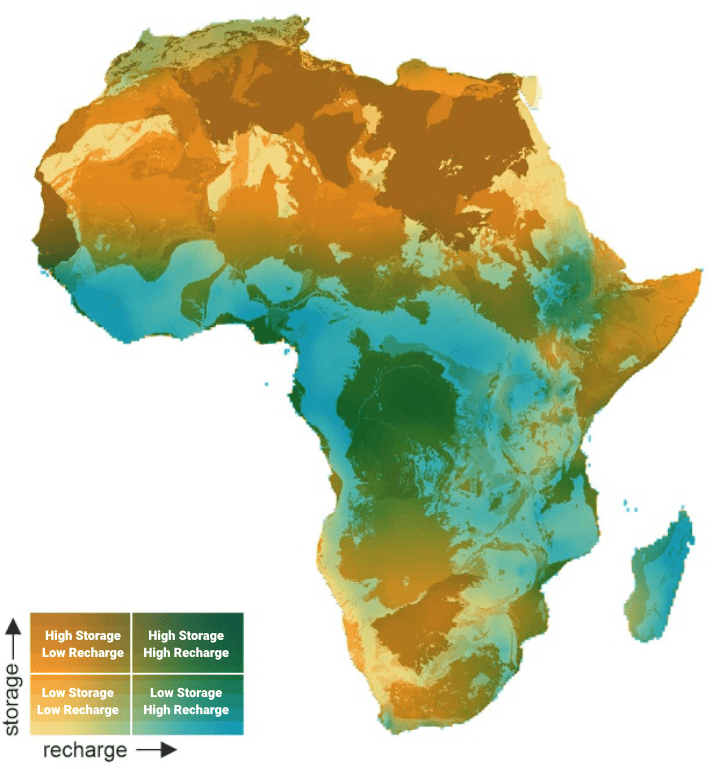
Understanding how quickly freshwater aquifers recharge is one of the key components in assessing the development potential of groundwater resources. If an aquifer recharges quickly then sustainable extraction of water from the underground system may be possible.
The key, however, is sustainable extraction. If water is pumped out quicker than the aquifer can replenish then water sources may quickly run dry.
Why is this research important?
Water security is one of the biggest challenges currently facing the African continent. With Africa’s population projected to exceed 2.5 billion by 2050 (an ~87% increase from 2020) and changing precipitation patterns resulting from climate change, the challenges and impacts of persistent water scarcity will only intensify.
The challenges presented by water scarcity are multi-faceted, including poor health and disease, food scarcity, conflict over water resources, gender and education inequality, and the destruction of unique ecosystems and biodiversity.
“It shows where there is potential to sustainability develop more groundwater and also highlights where efforts should be targeted to carefully monitor groundwater supplies vulnerable to drought.”
Prof Alan MacDonald, Hydrogeologist, BGS
By providing a more comprehensive and detailed view of Africa’s ground water resources, this study provides a valuable contribution to enhancing Africa’s water security. It also provides a reliable benchmark for more localised studies and future research.
Geology and Sustainable Development
This research exemplifies the essential role that geology plays in securing and developing sustainable water resources. And in doing so, hydrogeology directly and indirectly contributes to at least 11 of the UN’s Sustainable Development Goals (SDGs).

Want to know more?
Water scarcity: https://www.worldwildlife.org/threats/water-scarcity
UN Sustainable Development Goals (SDGs): https://sdgs.un.org/goals
British Geological Survey (BGS): https://www.bgs.ac.uk
Hydrogeology: https://www.geolsoc.org.uk/Geology-Career-Pathways/Careers/Job-Sectors/Hydrogeology-Sector

 Finite.Earth